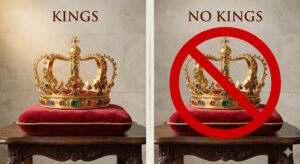
On the last weekend of March 2026, an American mass protest coincided with the beginning of the most sacred week in the Christian year. On Saturday, an estimated eight million people in more than 3,000 locations joined the “No Kings” rally, the third such occasion since June 2025. On Sunday, millions of Christians around the world celebrated the triumphal entry of Jesus into Jerusalem commonly called “Palm Sunday” and the beginning of “Holy Week” on the Christian calendar.
Both events recognize pieces of a struggle throughout human history that has been interpreted similarly by secular historians on the one hand and Biblical scholars on the other hand. The struggle pits empires and kings on one side of history and mass movements of ordinary people on the other side. Each side claims to have divine support. I want to examine very briefly two examples, one from American history and the other from the Bible. In doing so, I don’t pretend to give a comprehensive universally applicable analysis. Rather, I suggest some similarities that from a Christian perspective may link many events in human history.
In the past several years, I have read with much interest the writings of American historian Heather Cox Richardson, particularly her daily Substack postings entitled “Letters from an American.” Professor Richardson views American history as a struggle between competing philosophies of national governance. On one side is the notion of a king and/or a specific class of people specially fit to govern a people or country. That supposed fitness can reside in a number of factors such as race, genealogy, education, religious belief, wealth, class, etc. The theory holds that common people are not fit to govern and therefore always need to defer to the king or governing class. At the beginning of America’s history, this view was represented by the British King George III.
On the other hand, Richardson presents the ordinary folks in the American colonies. Many of them came from Britain where they had acquired a taste of their own rights and privileges as the British people sought to limit the rights of the monarchy. Added to that history was the Enlightenment philosophy that recognized the inherent dignity of all human beings. Thus, the American patriots sought to set up a representative democracy. Its most famous expression was that of Thomas Jefferson in the Declaration of Independence which said, “all men are created equal.”
Yet, as Richardson repeatedly points out, there have always been movements in American history that want to define “kings” in a new way to maintain their favorite status quo. People in power seek to justify the dominance of their elite smaller group over the larger group, “the masses.” Even the initial patriot movement had its hierarchy or its oligarchy. Men were fit to govern; women weren’t. White men were inherently more capable, black men were considered clearly inferior. Property owners were entitled to rule. Common laborers, whether slave or free, had to take a back seat.
Against a backdrop of prevailing power structures, American history can be viewed through the lens of new groups of people rising up and asserting that they too were “created equal” and “endowed by their Creator with certain unalienable Rights…” When these new groups are recognized in some fashion, socially or legally, a backlash ensues as those asserting their superiority create new criteria to justify their claims. American history is a struggle as the “kings” resist the claims of the “no kings” movement. The most intense of these conflicts, of course, was the American Civil War in the middle of the 19th century. But Richardson cites many other examples in American history which set the stage for the struggle in our present day.
America is not alone in experiencing this struggle of “kings” vs. “no kings.” The Bible itself is a witness to this historic dynamic. Walter Brueggeman is an Old Testament scholar who has brought this struggle to the attention of Bible students in the past generation. His most well-known book is The Prophetic Imagination which was published in a 40th Anniversary Edition in 2018. Brueggeman contrasts the “prophetic imagination” with what he calls the “royal consciousness.” The struggle forms the very heart of the Hebrew Scriptures, or what Christians call the “Old Testament.”
The story starts with Moses who receives a unique revelation of who God is: Yahweh, the Creator and source of all being and thus ultimate reality. The royal consciousness is represented first by the leadership of Egypt, the greatest empire of the day. Each empire has its own gods who spiritually represent the principles of empire. The first result of the Biblical struggle is that a ragtag people referred to as Hebrews, come together around a common spiritual ancestry represented by Abraham, Isaac, and Jacob (Israel). They become the Israelites, a “no kings” movement who follow a different God. They are liberated from Egypt, wander for 40 years in the wilderness, and end up largely taking over the land of Canaan.
Yet, after entering this “Promised Land” the Biblical story goes on to show that the Israelites lost their connection to the God of Jacob and Moses. They were constantly influenced by the powers and gods of the people around them. Even Samuel, a recognized man of God in their midst, was not able to help them fully overcome this ever-creeping resurgence of the royal consciousness. The clash of viewpoints culminates in 1 Samuel 8 where the elders of Israel come to Samuel and say “…appoint for us, then, a king to govern us, like other nations.” (1 Samuel 8:5 NRSVue)
God makes it clear to Samuel that the request for a king is not the rejection of human leadership that Samuel has given, but rather the underlying leadership of God through Samuel. …7 and the Lord said to Samuel, “Listen to the voice of the people in all that they say to you, for they have not rejected you, but they have rejected me from being king over them. (1 Samuel 8:7 NRSVue) God does not force the people to accept God’s sovereignty but rather warns them of the dire consequences of giving in to the royal consciousness and expecting a single human ruler to successfully govern their life together.
The rest of the Old Testament is the story of how this royal consciousness gradually divides Israel, destroys their spiritual life, and eventually leads them into exile, subject to an even greater empire. Even the temple itself, the construction of Israel’s most powerful king and the symbol of Israel’s lip service to the God who had liberated them, is destroyed by the very mindset of royal consciousness that is unleashed. Political power cannot and does not save them.
Over against the establishment of Israel as a “kingdom” is the countering “no kings” movement which comes via the prophets. It is no accident that following the story of how Israel got a king (and then divided into two kingdoms) much of the rest of the Old Testament is dominated by the prophets. Prophets were the voices of God among the people. Of course, there were also false prophets who essentially told both the people and their royalty what they wanted to hear. But true prophets were known by whether and how their words were proved to be true as Israel’s history unfolded. Even when the word of the prophets was stark and grim and spoke of the coming disastrous consequences, the prophets looked forward to a new, even better future. This is what Brueggeman calls the “prophetic imagination,” a way of visualizing what true human community under God’s rule looks like.
Thus, it is this prophetic imagination that keeps Israelite peoplehood together when their nations fall. The kings and their extended families were taken captive and made to serve a huge empire, whether it was Babylon, Assyria, or Persia. In exile, the Israelite people had no king to rally around with a promise that they would go back home. The best they can do is imagine an ideal king who would once again lead Israel back to glory.
This prophetic imagination led to the vision of the Messiah (meaning “Anointed One”), a new leader anointed by God to restore Israel as a people of God. The prophets had many different visions of what this messianic leader would be like. Some envisioned a military general who would simply expel Israel’s foreign conquerors. Others envisioned a world conqueror who would lead all nations, not just the tiny people of Israel. Some envisioned a leader who would be a shepherd or a servant, leadership images that were very different from a king with vast military power. In all of this longing for something beyond exile was a mixture of the ever-lingering royal consciousness and, at the same time, the constant call of God to a prophetic imagination.
Then comes Jesus. Looking back, the Christian Church affirms that Jesus was this Messiah, the anointed one that Israel longed for and at the same time Lord over all the earth. This title of “Lord” communicated the same idea of sovereignty to the non-Jews (Gentiles) as “Messiah” did for the Jews. Calling Jesus “Lord” also put him in direct competition with the emperor who asserted the claims of the royal consciousness that “Caesar is Lord.”
However, it is noteworthy that Jesus was tremendously reluctant to accept any kingly titles such as “Messiah” or “Son of God.” The reason was precisely because such titles carried too many of the connotations of the royal consciousness. Jesus did not want to be seen as a king or political leader as commonly envisioned by the masses of people. He hushed the folks he healed when they wanted to portray him as God. After he fed 5,000 people, the Gospel of John says, 15 When Jesus realized that they were about to come and take him by force to make him king, he withdrew again to the mountain by himself. (John 6:15 NRSVue)
Even though he could have claimed kingship, Jesus identified himself with the “no kings” movement in Israelite history, the Hebrew prophets. He referred to himself with non-royal and non-military images such as “shepherd,” “servant,” “Son of Man,” “water of life,” “bread of life,” etc.
Neither did Jesus fully identify with any of the political or religious parties of his day.
- He was clearly not a Sadducee who simply adapted to and cooperated with the latest version of royal consciousness represented by the ruling Roman Empire.
- At the other end of the political spectrum, Jesus was not a Zealot, seeking any alternative to Rome including revolutionary violence if it would result in Jewish home rule.
- Perhaps the closest Jesus came to any party affiliation was the pietism of the Pharisees. Unlike the Sadducees, the Pharisees had no love for the royal consciousness of Rome. They sought Jewish rule over the homeland, but they also rejected the violence of the Zealots. The Pharisees advocated a purely religious solution. They sought to force God’s hand to establish a Jewish royal consciousness by so fully keeping God’s Law that God would bring in the Kingdom. Yet of all of these groups, Jesus was most critical of the Pharisees and sought to differentiate his teaching from theirs.
- Neither did Jesus identify with the Essenes. The Essenes essentially withdrew from society to form their own more perfect community in the wilderness. They considered this the way to bring in the Kingdom. But that was not Jesus’s way either.
Nowhere is this “no kings” posture more evident than in the last week of Jesus’s life, what Christians have come to call “Holy Week.” The week begins with what has become known as Jesus’s “Triumphal Entry into Jerusalem” or “Palm Sunday.” On the surface, this triumphal entry looks like that of a military conqueror coming to take over the government. But Jesus has a different point of reference, a different way of envisioning kingship. It starts by the animal he rides, not the proud warhorse of a conquering general, but a donkey, the everyday transportation vehicle of the common people.
In choosing a donkey, Jesus expressly recalls the prophetic tradition of the Old Testament instead of the royal tradition. The specific reference is to the prophet Zechariah in Zechariah 9:9–10. Zechariah himself draws upon the prophets Isaiah and Micah in proclaiming this message:
9 Rejoice greatly, O daughter Zion!
Shout aloud, O daughter Jerusalem!
See, your king comes to you;
triumphant and victorious is he…
Thus far the royal language seems to dominate, but then Zechariah adds
humble and riding on a donkey,
on a colt, the foal of a donkey.
Not proud and strutting on a war horse, a purebred warhorse, but humble and riding on a donkey, / on a colt, the foal of a donkey.
From there onward, Zechariah goes on to dismantle all of the warring military images commonly associated with a military Messiah.
10 He will cut off the chariot from Ephraim
and the war horse from Jerusalem;
and the battle bow shall be cut off,
Rather than more war and battle
…he shall command peace to the nations;
his dominion shall be from sea to sea
and from the River to the ends of the earth.
It is to this prophetic “no kings” tradition that Jesus refers in his “triumphal entry” into the capital city of Jerusalem. At the end of the march, Jesus does not storm the Roman fortress but rather enters the temple. He chased out the folks making a profit from worship. Then, 14 The blind and the lame came to him in the temple, and he cured them. (Matthew 21:14 NRSVue) When the religious authorities complained, he affirmed the praises of the children. Then 17 He left them, went out of the city to Bethany, and spent the night there. (Matthew 21:17 NRSVue)
The rest of the week was devoted to teaching, some directed at the crowds, other teaching in more intimate settings of the closest disciples. When the final crisis scene unfolded, Jesus was in the garden praying. By this time, even the closest disciples were overpowered by the royal consciousness. They fell asleep rather than praying with Jesus, and one of them drew a sword to defend Jesus while the rest slunk away.
Jesus made it clear that he could have chosen to cast his lot with the kings instead of the prophets. 51 Suddenly one of those with Jesus put his hand on his sword, drew it, and struck the slave of the high priest, cutting off his ear. 52 Then Jesus said to him, “Put your sword back into its place, for all who take the sword will die by the sword. 53 Do you think that I cannot appeal to my Father, and he will at once send me more than twelve legions of angels? (Matthew 26:51–53 NRSVue)
Instead of the military option, Jesus chose the humble “no kings” option, the option expressed in the whole of scripture and particularly the prophets. Yes, he could have chosen the legions of angels. 54 But how then would the scriptures be fulfilled, which say it must happen in this way?” (Matthew 26:54 NRSVue)
By Friday of Holy Week, it becomes obvious that the way of the cross is the “no kings” way. The sacrifice of Jesus represents the total surrender of all earthly power of kings and princes, of presidents and prime ministers, of political parties and military powers. Jesus dies on that Roman cross. That is what we remember each year. Yet, on Resurrection Sunday, God proclaims to the whole world that “Jesus is Lord” and that the power of love has overcome all the powers of this world. One would think that that the victory of the prophetic movement over the royal consciousness would be viewed as decisive and final.
Unfortunately, the essential historical struggle of the church has been no different than the story of ancient Israel. The Roman emperor who can’t defeat Christianity decides to join it and dilute its faith. Instead of every person choosing whether to follow the Lord Jesus, they are baptized into the ruling prince’s version of Christianity. The political kings dictate the terms by naming everyone “Christian” and then wielding their power over them. A movement of the people shifts into obedience to a new empire, a new Babylon. Throughout history, as new “no kings” movements arise to protest, the kings persecute and torture and kill those who follow Jesus as Lord.
Heather Cox Richardson is right that the secular version of this struggle is playing out right before our eyes. Our American political leaders fancy themselves as the new royalty, those with the right birthright and bloodline, the right political movement and ideology to lead and indeed suppress the “woke” masses. Will we accept and obey those who would propose to be our new royal rulers? Or will we listen to all of the prophetic voices in our society? Will we allow God to filter and shape all of our various differences of race, culture, sexuality, and opinion into a new people rooted in the love of Jesus?
Jesus humbly gave his life even unto death, following in the prophetic “no kings” tradition. We may rightly call Jesus “King.” But Resurrection Sunday has now redefined what kingship and lordship means in God’s terms. The power of sacrificial love prevails over all of the political powers of this world. The Lion of Judah has become the Lamb that was slaughtered. Jesus who was crucified is Lord, the Sovereign of Heaven and Earth!