First of a 2-part series
The Christmas season ends too early for most American Christians. Most of us are so busy following the Christmas shopping season that when Christmas Day comes, we are ready to end our celebration rather than begin it.
But the Christmas season really begins on December 25, and it ends on January 6, the Day of Epiphany. Before Christmas Day, our churches often focus on the Christmas story as told in the Gospel of Luke. It’s a powerful story of the Annunciation to Mary, the birth of John the Baptist, Mary and Joseph’s trek to Bethlehem, and the glorious announcement to the shepherds. We’ve also often made it into a romantic story.
However, the Gospel of Matthew also tells about the birth of Jesus. Matthew chapters 1 and 2 give us a different perspective, one that stretches on past the baby in the manger to extend to a true celebration of the Twelve Days of Christmas and the Day of Epiphany. In Matthew, the story is not focused the romanticized “baby in the manger.” Instead, we have five major sections in the first two chapters that could be described as “scandals and signs.” The story of Jesus’s birth then connects with the rest of Matthew’s story from ministry to cross to the mission of the risen Jesus. In this article, we will examine the first two sections (Chapter 1) of scandals and signs in the genealogy and Matthew’s birth story. In Part 2, we will look at Chapter 2.
First, though, come the questions: What is a scandal? What is a sign? Both scandal and sign indicate something unusual. A scandal is something unusual that seems wrong and brings outrage and disgrace. A sign, on the other hand, is also unusual, but not necessarily wrong. In the Bible, a sign often points to something which only God can do.
The root of the English word “scandal” is in the Greek word σκάνδαλον (skandalon) which appears in the New Testament of our Bibles more than a dozen times. Literally, the word refers to the stick in an animal trap where one attaches the bait. The animal trips up on the skandalon and is caught. A skandalon is a snare, a trap, an unusual object in an otherwise safe landscape. A trap causes someone walking through the land to stumble or fall.
In the New Testament, the word skandalon is usually translated as “stumbling block” or “offense.” Scandals are seen as public evidence that something is wrong. That doesn’t necessarily mean that what is wrong is evident on the surface. Rather, a scandal points to something corrupt and often beneath the surface. There is something wrong with the whole situation. For example, the Apostle Paul refers to the cross of Jesus itself as a skandalon, a stumbling block, an offense to most people. Messiahs and crosses don’t go together. There is something wrong with this picture, a scandal, a stumbling block in the eyes of most people.
Yet, in the Bible, scandals can become signs of God at work. That’s what the Gospel of Matthew is trying to tell us. Matthew is usually considered the one Gospel account writing to convince Jews that Jesus is the Messiah that they have been waiting for. Indeed, Matthew clearly starts by addressing the common image of what a Messiah would look like. Yet, when he gets into the details, the evidence Matthew cites is puzzling at best. The details are scandalous compared to that ideal image of a Jewish Messiah. So let’s look at the Matthew Chapter 1.
The Genealogy
Matthew makes it very clear from the first verse that his story is about Jesus who he claims to be the Messiah. An account of the genealogy of Jesus the Messiah, the son of David, the son of Abraham. Matthew 1:1 (NRSVue)
While there were multiple men named “Jesus” in Matthew’s day, this is a particular Jesus, “the Messiah” or “the Christ.” “Messiah” derives from the Hebrew word, and “Christ” derives from the Greek equivalent. The meaning of both words is literally “the anointed one.” Most Jews would have clearly understood that this meant the chosen king. Kings were anointed with oil, a symbol of God’s Spirit, as a sign that they were chosen by God.
Secondly, Matthew declares that Jesus was God’s chosen king for God’s chosen people, Israel. He is the son (descendant) of David, the model king in Israel’s history. Going even further back, Jesus is the son of Abraham, the original ancestor of Israel, the one to whom every Israelite could trace their lineage.
From this introductory verse follows a genealogy, what many modern readers consider a boring litany of “begats” to use the old English word from the King James Version. Yet, genealogies were important in Matthew’s day. This genealogy clearly links Jesus to Israel’s first ancestor, Abraham, and to Israel’s kingly line beginning with David who came from the tribe of Judah.
Yet, the genealogy also implies a question, “Who is a true Israelite?” “Who actually belongs in this people of God?” Jews in that day, like many people in our day, like to answer that question by tracing a clear line of racial and ethnic purity. That is generally the reason for genealogies—to prove that someone comes from pure and noble ancestors and therefore is special. On the surface, it looks like that’s what Matthew is doing here. Yet if we look more closely, we discover that the story of a pure-blooded Jewish Messiah in this Jesus is in question by what I am calling “scandals and signs.”
We note first that a genealogy is mostly about men. But, in the midst of a text that some man begat another man, or, in the newer versions, was the father of someone who was the father of someone else, etc. we find the story interrupted by women. Women don’t appear in genealogies of that time unless they were significant. Thus, these aren’t just any women. They each come with a story—a story that shatters the image a pure-blooded Israelite Messiah King.
On the surface, they would be an offense, a stumbling block to any Jew you were trying to convince that Jesus was really the Messiah. Yet, when the readers are honest and dig deeper, they realize the very notion that there is such a thing as a pure-blooded Israelite is itself a fantasy or a scandal.
Tamar
The first woman to appear on the list is Tamar in Matthew 1:3. Her story is complicated. She is first of all, the daughter-in-law of Judah, the ancestor of the tribe of Judah from which Jesus the Messiah comes. Judah first takes a wife from the pagan people of Canaan, spoiling this idea of a pure bloodline right from the start. This means that Tamar was likely also a Canaanite. She was the wife of Judah’s mixed-race son, Er, who died young as a result of God’s judgment.
Then Tamar was wife of Judah’s second son, Onan, who, in that culture, was supposed to raise up an inheritance for his brother, but refused. So he also died in disobedience. This leaves the father, Judah, in a quandary. He wasn’t eager to give Tamar to his third son, Shelah, as the law required. Instead, he sent Tamar back to her father’s household.
But Tamar wouldn’t give up in her quest to give Judah an heir. She pretended to be a prostitute, Judah fell for her trap, and Tamar gave birth to twin boys. One of them, Perez, is in the line of David and thus of Jesus. Tamar, the foreigner, saved the family line of the whole tribe of Judah which eventually led to the royal line which led to Jesus, the Messiah. A scandal became a sign.
Rahab
Rahab is the next woman Matthew lists in his genealogy in v. 5. In the Old Testament book of Joshua, Rahab is a foreign prostitute living in the Canaanite city of Jericho. When Joshua sent two men to spy on the city of Jericho, Rahab saved them from a lynching and almost certain death at the hands of the Jericho patriot militia. In return, Rahab’s family was spared when the walls came tumbling down around Jericho and Israel conquered the city. Rahab was given in marriage to a man named Salmon and had a son, Boaz, again in the line of Judah leading to King David. Rahab the prostitute was faithful to God’s people and God’s purposes. A scandal became a sign.
Ruth
Rahab’s son, Boaz, shows up in the next woman in Matthew’s genealogy: Ruth. Ruth was another foreigner, a Moabite woman who was married briefly to an Israelite man who lived in her land but died before having any children. As a widow, Ruth chose to return to Israel with her also-widowed mother-in-law, Naomi. There, with the help of Naomi, she found a sneaky way to once again get a man to do his duty to maintain the family line. She married Boaz and together they became the great-grandparents of King David through their son Obed, the father of Jesse, the father of David. A foreigner’s scandal became a sign leading to the Messiah.
Bathsheba
That brings us to the next woman in Matthew’s genealogy. Matthew doesn’t even name her, calling her only the “wife of Uriah.” We know her name from 2 Samuel 11 as Bathsheba, but we don’t know for sure if she was an Israelite or, like her husband, Uriah, a Hittite.
Even though Uriah was a Hittite, a foreigner, he was a loyal soldier of King David of Israel. The scandal in this story belongs not to the racial background of either Uriah or Bathsheba, but to David’s own sinful actions. First, he raped Bathsheba, asserting the common royal privilege of the day to take and use any woman he saw fit. But then he covered up his actions by arranging for Uriah’s death in battle. The resulting baby died in infancy, and David mourned in repentance. Yet Bathsheba remained David’s wife and their next son was Solomon. David promised Bathsheba that Solomon would be David’s successor on the throne instead of Adonijah who would have normally been first in line. Solomon became the most famous Israelite king in ancient world at the time. A royal scandal became the sign of the Messiah.
So much for a pure and noble family blood line of Jesus, the Messiah. Instead, we see a series of scandals introduced by Matthew through the addition of key women into Jesus’s family line. It’s not that the women created the scandals. Rather, they were the faithful ones, even when the men became unfaithful to God. Yes, Jesus is born of the tribe of Judah in the family line of King David. But it’s not so much about a pure Jewish bloodline to bring Messiah into the world. Instead, God uses ordinary lowly women, who are faithful to God’s will. The scandals become signs in God’s plans.
Mary
At the end of Matthew’s genealogy is the last woman mentioned: Mary, the mother of Jesus. Mary is betrothed or engaged to Joseph, at the end of the family line of David that brings Jesus into the world. But there is also a scandal, a stumbling block, here. Mary is pregnant, but not by Joseph, and Matthew relates how Joseph is about to end the marriage. So, Joseph is not the father in the normal biological sense of the word.
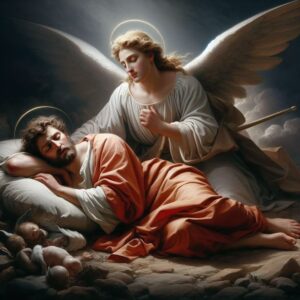
But then God shows up to Joseph to turn a scandal into a sign. A heavenly messenger or “angel of the Lord” appeared to Joseph in a dream. The angel said specifically, “Joseph, son of David, do not be afraid to take Mary as your wife, for the child conceived in her is from the Holy Spirit.” In other words, Mary’s pregnancy is not the result of the actions of another man; rather, “…the child conceived in her is from the Holy Spirit.”
Nevertheless, in that day, if a man took a woman as his wife, he was declaring to the world that her children were his children. Today, we might call that “adoption,” legally taking a child as one’s own. What mattered back then is, that despite the scandalous whispers, Joseph accepted the word of God’s messenger. Joseph, specifically called the “son of David” by the angel, took Mary as his wife and thereby gave Jesus his kingly heritage from a human point of view.
This is what Matthew wants to communicate to his Jewish readers. Even though the circumstances are unusual and even scandalous to many, this is the work of God to bring the Messiah into the royal line of David as God had promised many years earlier.
This is further confirmed as Joseph accepts his responsibility to name the child born to Mary as his child, yet with a unique identity. The angel had said, She will bear a son, and you are to name him Jesus [the Lord saves], for he will save his people from their sins.” (Matthew 1:21)
Matthew also wants to make sure his readers appreciate the fulfillment of an Old Testament prophecy by giving the child another name, “Emmanuel” which means, “God is with us.” Joseph, the adoptive father, confirms the work of the Father in Heaven, through whose Spirit Mary conceives and gives birth to Jesus. Matthew concludes by saying, 24 When Joseph awoke from sleep, he did as the angel of the Lord commanded him; he took her as his wife 25 but had no marital relations with her until she had given birth to a son, and he named him Jesus. (Matthew 1:24-25) What is commonly considered as scandal has become a sign of God at work.
Thus, Matthew establishes for his readers that Jesus legitimately carries the names and titles given to him. He is the Son of David, the Messiah, who came into the earthly family of David. He is Emmanuel, God with us, indeed with all of us, God in the flesh. He is also the Savior from God, reflected in his given name, Jesus. This is God working through small acts of human faithfulness (initiated by women no less) in the midst of otherwise scandalous circumstances.
The point is not to either condone or condemn what these men and women did. Rather, it is to marvel at the work of God and the grace of God. Such signs should also move us to humility as we face our own human foibles and yet give them along with our whole selves to God who alone can bring salvation.
In short, the scandals become signs in two primary ways:
- Jesus is born, as promised, in the line of David. Yet his legitimacy as Messiah is not from a perfect bloodline. Indeed, the ancestry of Jesus is sprinkled with foreigners of questionable reputation from the very beginning.
- Jesus is the Savior and Son of God to be sure. Yet his status is not based on some litany of moral perfection through the ages. The actors are all flawed human beings. Jesus is not the Savior because he represents the culmination of a perfect genealogy.
In short, Jesus is Messiah because God does a unique work to bring his Son into a messy scandalous world to bring God’s own salvation.
In Part 2, Matthew Chapter 2, we will continue and amplify the story with more scandals and signs. In addition, we will connect this story of the birth of Jesus with the ministry of Jesus and the resurrection and ascension of Jesus to his kingly throne.